Tuesday, April 14, 2009

Part I - Chapter 3

September 25, 1870

The Army of the Rhine, until recently stationed at Metz, begins marching into Prussian lands. The army, totaling 230,000 men, is commanded overall by Napoleon III, but in reality it is Marshals Bazaine and Trochu who run the show.

Opposing the Army of the Rhine is the 185,000-strong First and Second Armies, the Third being preoccoupied with holding back the Allied incursion from the south. However, the Prussians do have one advantage named Helmuth von Moltke.


Helmuth von Moltke. Prussian. Field Marshal. Genius.


Progress by nightfall on the first day is very good. The Prussian high command is in complete dissary after the recent Allied victory at Wiesbaden, and is not able to react quickly.

October 1, 1870

The French Army of the Rhine, after having advanced some 80 kilometers, reaches the Rhine, cutting off almost 200,000 Prussian soldiers from help. Unfortunatly, Von Moltke manages to escape with his entire staff.


Encircled!


October 3, 1870

The Prussian forces inside the "Saar Pocket" attempt a breakout. Leading elements of the First Army, the creme of the Prussian Army, assault a thin area of the French line, breaking through in a few pieces. The brave men of these regiments manage to hold back the Allies long enough to allow almost 15,000 of the best soldiers in Europe to escape. However, the hole collapses by noon on the 4th.

October 14, 1870

Napoleon III sends an ultimanium to the commander of the forces inside the Saar Pocket: Surrender within 48 hours, or you will be assaulted and anniliated. The Soldiers in the pocket are rapidly running out of food, water, ammunition, and most importantly, medical supplies. It will be very hard to keep on fighting.

October 16, 1870

Marshal Trochu is on the verge of ordering the attack when a Prussian under the flag of truce appeared at his command tent. He has brought word that the Prussians inside the pocket will surrender unconditionally. Napoleon actually jumps with joy after recieving the news. Now the only force inbetween the Allied armies and Berlin is a rag-tag group of defeated Germans under the Crown Prince...

To Be Continued....

Part I - Chapter 2

August 9, 1870
The First major battle in the south begins. In the plains about 50 miles south of Frankfurt, the Prussian IV Corps comes into contact with elements of the 1st Bavarian Army. The Bavarians decided to make a retreat so that their French and Austrian comrades can come and help. The two armies meet each other at about 3 PM. The Prussians, with about 20,000 men against the 75,000 Allies, put up stoic resistance, holding out until night comes and the firing stops, for the most part.


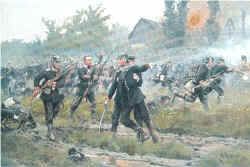
Bavarian Infantry charging out of the woods.

August 10, 1870

Battle resumes on the fields of Frankfurt at around 5 AM. Prussian Jägers make a name for themselves by picking off infantry officers as they lead their troops into battle. However, no amount of sharpshooters can turn the tide of the Allies, and the IV Corps retreats after about four hours of fighting and 9,000 dead. The Allies on the other hand, suffer a moderate 5,000 dead. The French bear the brunt of the casualties, so the French 3rd Division of IV Corps is brought in to replenish losses.

Von Moltke sees what the Allies are trying to do. By holding the French border and allowing the south to be the main line of offense, the French can cut off the Prussian Army’s supplies. He desperately drafts orders for more men to join IV Corps in halting the Allied advance.

August 12, 1870

In Dresden, King John I of Saxony declares War on Prussia and the North German Confederation. In Berlin Otto von Bismarck flies into a rage. “Only with the full weight of Germany behind us,” he says, “Can we triumph!”

On this same day, Archduke Albert finally begins his attack into Prussian Silesia. The Army of Bohemia consists of more than 115,000 men and was still growing when it began marching. The Prussians have been expecting this for some time and Albert will be met with strong defensive positions.

August 14, 1870

Elements of the Army of Tyrol reach the outskirts of Wiesbaden on the Rhine.

August 16, 1870


Prussia launches a counterattack against the Allied Army in Wiesbaden. The Prussian Third Army, consisting of roughly 90,000 men face off against the combined Prussian, Austrian, and Bavarian armies, totaling 95,000 men.

From the start the battle is a disaster for the Allies. Marshal MacMahon is away in Metz conferring with Emperor Napoleon III and therefore the command is passed to the inexperienced Marshal François Canrobert. Also, the Prussians intentionally attack only the Bavarians, who are generally soldiers of a poorer-quality than the French or even Austrians.

The Prussians, on the other hand, are led by the extremely bright Crown Prince Friedrich, they enjoy a standard of training better than any in Europe, and, for the most part, superior technology.

The Battle is the largest of the war, to date. The blistering hot August sun makes fighting no less difficult. Within two hours of fighting the Bavarians break, leaving the entire right flank of the Allied position vulnerable. Friedrich immediately sends in the brilliant-looking Prussian Cruassiers to wreak havoc in the Allied rear. Needless to say, the cavalry are very much successful in this endeavor, and the entire Allied army is forced to retreat with as much haste as possible.

It is a complete and utter defeat for the Allies, as they are pushed from the Rhine.


Cruassiers charging the Guns at Wiesbaden

August 30, 1870

In the face of very strong Prussian defenses, the Austrian offensive is halted after only gaining a few miles inside of Prussia. Franz Josef is furious, but soon calms down after Albert sends word of his new battle plan.

The Prussians, meanwhile, use this lapse in action as precious time to strengthen their fortifications. This formidable line of forts and bunkers is being called the "Bismarck Line" by the press.


One of the strongpoints in the Bismarck Line


September 5, 1870

The Allied army in the south, having a good three weeks of rest, once again is on the march. The force has been reinforced with two Austrian corps, and a division of Saxons. The Saxon force is especially needed, for most of the men in it fought against von Moltke and the Prussians in 1866, and are very good soldiers.

The Allies are making very good progress on the first day, gaining almost 10 miles before nightfall.

September 8, 1870

The Allies reach Wiesbaden for the second time. Greeting them are Prussian soldiers of the Third Army. It seems that the Second battle for Wiesbaden is about to be fought.

September 9, 1870

125,000 Allies meet 100,000 Prussians on the plains near Wiesbaden. Crown Prince Friedrich makes the first move, sending in his Cavalry to force the Allied infantry to form squares. This time, Marshal MacMahon is present and sends in his own cavalry to chase the Prussian horse from the field.

The Marshal is not finished quite yet. He orders french infantry to strike at the Prussian flanks, drawing attention from the center. Crown Prince Friedrich does exactly what MacMahon wants him to do, and sends some of his precious men to the flanks to beat back the french. MacMahon then sends in his Austrian and German infantry to take the center, and wrap the Prussians up.

Friedrich senses a trap, all too late. He throws the last of his reserves into the center, but even this is not enough. The Austro-German force sweeps the Germans from the field with steel, courage and sheer weight of numbers. The Prussians fight valiantly, but this is simply not enough. The Prussian retreat from Wiesbaden quickly turns into a rout, as the French and Austrian cavalry runs down a good many retreating Germans.

As many as 45,000 Prussians surrendered, and the way to the Rhine was open.


The Battle of Wiesbaden


To Be Continued….

Friday, April 10, 2009

Part I - Chapter 1

In the end history is simply a explosive chair reaction. One single event, not matter how small and insignificant it may seem at the time, may or may not turn out to be just the right trigger to start an event that can radically change the world for years, decades, even centuries to come. These "gunpowder" events, are the cornerstones of history. They can also lead people to wonder "What if...?" Well, friends, I have often sat and wondered "What if..?" about a great many things, and this is probably the most explosive of all the "gunpowder" events I have podered.

What If...? France's pleas to Austria and Bavaria in 1870 had gotten through, and Prussia had lost the Franco-German War, therfore not allowing a unified Germany to form?

---------------------------------------------------------------

Our little endeavor into the What If? begins on the flat plains of Northern Europe. For months, conflict had been brewing in Europe. In Paris, an extremely ambitious Napoleon III had been looking warily at King Wilhelm of Prussia, or more importantly, Chancellor Otto von Bismarck. Tensions between these two military powerhouses had been brewing since 1867, when Prussia and the North German Confederation blocked France's purchase of Luxembourg from The Neatherlands. In early 1870 the Spanish Throne had no apparant heir. Otto von Bismarck eagerly offered Prince Leopold of Hohenzollern-Sigmaringen, a distant cousin of King Wilhelm of Prussia to the Spanish throne. A Furious Napoleon III immediatly sent a Telegram to Berlin instructing that either Prussia will cease it's current course or war will be declared.

Prussia kept it's current course.

July 19, 1870

Napoleon III of the Second French Empire declares war on The Kingdom of Prussia under King Wilhelm and Chancellor Otto von Bismarck. Almost immediatly, the North German Confederation backs Prussia by declaring war on France. The Southern German states of Bavaria, Baden, and Württemberg, and Saxony, always in competition with the North German States, are more reluctant to join any cause. It seems that it will take some persuasion to sway these small Kingdoms.

July 21, 1870

The first of Napoleon's diplomats begin discussions of alliance in Vienna. Kaiser Franz Josef of Austria-Hungary, still furious over Austria's humiliating defeat in 1866 listens intently to the alliance proposal.In Munich and Dresden, similiar discussions are also underway. In both cities, the French beat their Prussian counterparts by scarce hours. This will prove to be extremely fortunate for the French as the war continues.

July 28, 1870

Napoleon III joins up with the 100,000 strong Army of the Rhine in Metz. The French army is full of well-trained Regulars, some of which have fought in the Crimea, Italy, Algeria, and Mexico. The Army of the Rhine is expected to grow dramatically as French Mobilisation continues. However, unknown to Napoleon, the Germans are mobilizing much faster, as the entire Prussian Army is made up of conscripts.

July 30, 1870

Austria-Hungary declares war on Prussia. The first reserves were called up as soon as hostilities began and have been concentrating in Bohemia for a few weeks now, and by now about 150,000 men are ready for action. Franz Josef chooses Archduke Albert to lead the force. The Archduke has an impressive record, defeating an Italian army more than twice the size of his own in the 1866 war.The Kingdom of Bavaria, it seems, had been waiting for this exact event, for scarce hours later, it also declares war on Prussia and her allies.

August 2, 1870

French General Frossard's II Corps and Marshal Bazaine's III Corps cross into Germany, evicting the Germans from the vital city of Saarbrücken. In the short skirmish that ensued as the French entered the city, the French Chassepot rifle proved superior to the decade old Prussian Needle Gun.

French Zouaves outside of Saarbrucken.

Meanwhile, Marshals MacMahon and Canrobert are in planning with Bavarian and Austrian commanders on the strategy for the war in the south. I Corps under MacMahon in concert with the Bavarian army and the small Austrian Army of Tyrol would invade Palatinate and proceed to "liberate" southern germany, completely bypassing the 350,000 some men that von Moltke has arrayed on the French Border.

August 4, 1870

The first real battle of the war touches off at the small city of Wissembourg. The short, bloody battle occured when a single divison of the Army of the Rhine was attacked by two Prussian Corps. The Prussia attack was wild, uncoordinated, and undercommanded by the upper echelons of Prussian Command. This confusion, combined with a good defensive positon, allowed General Douay to successfully repluse three strong attacks by forces more than double the size of his. By the end of the day the French send in reinforcements and the field is taken by the French.

(Author's Note: In our time, the Prussians came to Wissembourg with two Prussian Corps, and one Bavarian Corps, the absence of the Bavarians, I believe, would allow the French to gain the upper hand, and eventully win this crucial battle.)

August 7, 1870

The war in the south begins. A Franco-Austrian force of about 60,000 coupled with the Bavarian Army invades Palatinate, finding little organized resistance. The Napoleonic allies are making very good progress before the day is out. Von Moltke immediatly dispatches a Corps to deal with the invasion.


To Be Continued....